|
| Thomas Finley's Plesioturtle |
With all the modern technology
hearing aids of the 21st Century
listening into the quiet
And lo - this is no longer a world of amber and silence.
This is a world full of voices and songs.
Ancient melodies modulating to a 200 million year old beat
And now that we have heard the songs and voices in the
amber what would they tell us
and are we going to listen ?
by Dr. Jacqueline Giles
At
Lake Champlain, the most common statement attributed to the famous Fauna Communications archives of unknown animals producing bioacoustics in the lake is that it must be a whale of some kind in order to create the type of signals obtained by Liz Von Muggenthaler and her team. The Beluga Whale is commonly evoked mostly because they are already known to produce echolocation and there have been 30 fossil specimens that have been dug up over the years in the Champlain valley, ancient remnants of a time when Champlain was still connected to the open sea - before about 10,000 years ago.
 |
The Charlotte Whale
Television specials on Champ quote biologists who state that "only whales" can produce these types of signals, and the sentiments are echoed often when basic aspects of the data are examined by lake cryptid investigators and fans. |
 |
| Dr. Lance Barrett Lennard with friends |
One voice of exception is Dr. Lance Barret Lennard, who has expressed doubt that the signals he analyzed from Fauna's charts were of cetaceans. Lance is well versed in analyzing whale signals in his day to day work at the respected Vancouver Cetacean Research Center. Dr. Lennard points out a quickly changing tempo of "calls" detected on the Fauna recordings that to him does not exactly resemble whale speech patterns. He feels that they are probably NOT signals of marine mammals.
He explains ... "A couple of features of this sound that don't particularly look like echolocation to me are that we don't hear an echo after each click and that the clicks are a bit uneven in their spacing, where as in cetaceans the intervals are evenly spaced, consistently" and if they increase or decrease in speed then it is done in a gradual ramping up or down fashion, "so this spacing would be unusual to hear in a marine mammal."
If they are not echolocation signals, then perhaps it's a form of communication. And if it doesn't seem to be marine mammal in origin, then what else in nature can make these kinds of sounds ?
________________________________________________________________________________
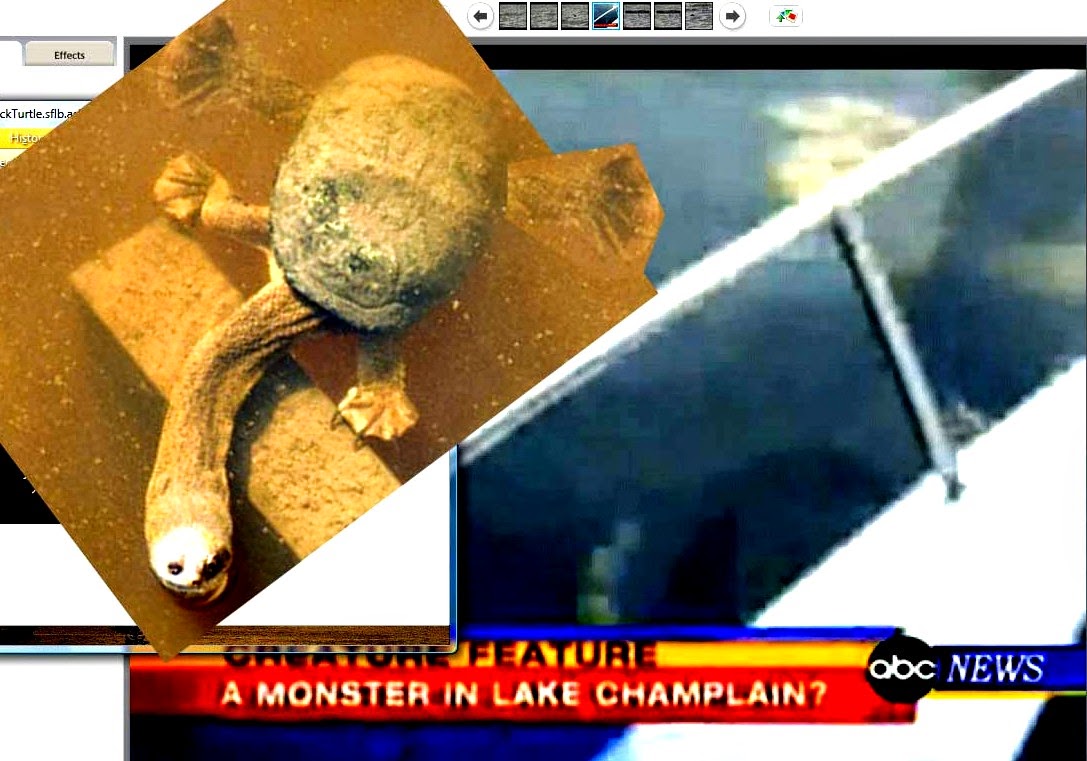 |
| Australian Snake neck Turtle compared to the Bodette animal |
In the past, turtles have not usually been considered much by lake cryptid researchers who generally believe that the creatures are Tanystropheus, whales, plesiosaurs, giant eels, Super Otters, long neck seals, giant salamanders, sturgeon, claims by attention getting people or claims by well intentioned, but mistaken folks.
 |
This is a job for SUPER-OTTER !
Upon investigating the order of Testudines it becomes clear that turtles, although not usually considered, are also one of the best candidates for some lake cryptid nominations, being that they are still alive (as in not extinct) as an order of animals and demonstrate extreme diversity and survivability in their present and past incarnations. There are no fossil examples of longneck seals or long necked whales, but there are fossil examples of huge Chelonians.
The world's largest lake turtle Stupendemys, lived recently, at the dawn of time for humans.
 |
| Stupendemys Geicographicus |
|
Part of the previously mentioned turtle diversity is being borne out by new discoveries that include unheralded findings in the study of animal acoustics in recognizing a new echo-locating aquatic animal. It's been found that there are echolocation type signals being generated by one of the world's more unusual and little known species of animals, from an order of animal that was here on earth long before the dinosaurs arrived and continues to thrive today, surviving countless extinctions of reptiles, mammals and fish over a quarter BILLION year survival.
A creature that amazingly fits the exact description of many Champ sightings, except for currently known size ...... the Snake Neck Turtle.

Top: Ben Radford's detailed rendering of original Mansi photograph
Bottom: Roti Island Snake Necked Turtle |
 One of the papers found while investigating was written by an Australian turtle researcher named Jacqueline Giles, who had discovered in 2003 that aquatic snake necked turtles indigenous to western Australia actually produced underwater acoustics of various complex types, with some signals exceeding the human hearing limitations - at times attaining frequencies inherent in cetacean recordings.
The family chelidae have been recognized for their similarity to long necked aquatic cryptids or "longnecks" as researchers call them, for some time. Then popular naturalist, "Land and Sea" author J.W. Buel commented over 100 years ago, "what a marvelous, miniature sea serpent the snake necked turtle is."
One of the papers found while investigating was written by an Australian turtle researcher named Jacqueline Giles, who had discovered in 2003 that aquatic snake necked turtles indigenous to western Australia actually produced underwater acoustics of various complex types, with some signals exceeding the human hearing limitations - at times attaining frequencies inherent in cetacean recordings.
The family chelidae have been recognized for their similarity to long necked aquatic cryptids or "longnecks" as researchers call them, for some time. Then popular naturalist, "Land and Sea" author J.W. Buel commented over 100 years ago, "what a marvelous, miniature sea serpent the snake necked turtle is."
 |
| Roti Island Snake Neck Turtle |
The original Giles report was published in 2005. The main objective of the research was to determine if the freshwater turtle Chelodina Oblonga produces underwater acoustics and whether their vocal activity could be related to behavioural or ecological aspects. One of the techniques used to determine that was to apply "call-blasting" of the recorded signals, that is playing back acoustically the recordings of the turtles and noting their reactions, a technique used by, but not invented by Bigfoot field investigators. Chelidae are a family within the sub-order Pleurodira. Mata Mata Turtles are Chelidae. This family is mostly noted for their extremely long necks.
These turtles often live in yellow - brownish - tannin stained waters, with impaired visibility - very similar to Loch Ness and Lake Champlain conditions. For aquatic animals like whales, sound is the most useful means of communication beyond their visual range.
 |
| Oblonga in tannin stained water |
500 hours of recordings were analyzed - taken at various wetlands through out southern
Australia, home of the turtles being investigated. Many distinct calls with a wide frequency variation were observed, revealing that these serpent necked turtles utilize an underwater acoustic communication system involving a repertoire of both complex percussive sounds and oscillations with short, medium and potentially long range propagation characteristics. Ultimately detected were calls of complex structures including rich and sparse harmonically related elements with different rates of frequency modulation. Frequency use extended beyond the in- air auditory sensitivity known from the family chelidae, with calls ranging from Bass register 100 hz to the Maria Carey-esque 20 kHz, which was the upper limit of the digital DAT recorder used, suggesting that the signal may have exceeded the limits of the machine.
The Giles tests, extending over 230 days, unexpectedly revealed that the snake necked turtles demonstrated 17 categories of vocal calls including clacks, clicks, squawks, hoots, chirps of various lengths, high calls, cries and wailing, cat whines, grunts, growls, bursts, staccatos, wild howls and drum rolling. Also noted were sustained pulse bouts used during breeding months though to be "calling songs." Echo-locating type signals were also detected and attributed to a clicking high frequency sound, with a high end of 20 kHz.
Later on the Acoustical Society of America (ASA) confirmed the findings went far beyond just echolocation and showed evidence of displaying complex social behavior, something never remotely attributed to "dumb" turtles before ..... except by Dr. Theodore Seuss.
The underwater bioacoustics of animals in a fresh water environment is a little explored realm, with most of the aquatic sound research so far being conducted in marine situations, and little of that research is dedicated to Chelonians. Until recently they had been considered "the silent group," not because they were silent - but because sound production in turtles was not given importance among scientists.
Fresh water lakes and ponds like the oceans and seas can have visibility impaired water by suspended vegetative matter such as peat stained Loch Ness, tannin stained waters and turbidity experienced on churning Lake Champlain, so sound production remains the best way for underwater animals to communicate in those conditions, also being that chemical and light sensing can be restricted by lack of light and direction of water current.
Leatherback Turtles (Derochelys Coriacea) living in turbid coastal conditions have been said to keep in touch with each other thru a series of audible (to us) chirps.
 |
| Leatherback Turtle by Rena Ekmanis |
Cetaceans like the Atlantic Bottlenose Dolphin, which live in turbid or muddy coastal waters - use echolocation to find food and to navigate. Experiments with Dolphins indicate that they detect great detail with their bioacoustic gifts. (Wood and Evans 1979)
Skin divers in Florida who are lucky enough to swim with Manatees will attest to their underwater clicking and knocking sounds. No echolocation is detected though.
 |
| Wild Manatees visiting Homosassa Springs Florida |
For animals living at depth in light restricting waters, it has long been suggested that auditory and vibratory stimulus would be an important type of communicating.
Countless other animals use vibratory sensors of different functions. Crocodiles for instance have a specialized organ called the "Dome Pressure Receptor" on the face that detects surface water disturbances.
The face of the Australian Snake Neck Turtle and other Pleurodira can also be festooned with barbels, tubercles and whiskers thought to perform multiple functions, one of them now being "receptor" like antenna for their communications.
Head of Champ with facial barbels ?
 |
Mata Mata Turtle from JW Buel's "Sea and Land" 1889
|
T
urtle sound research has focused on the sounds made by turtles when mating. Other late century contributions to turtle auditory research include the ideas of some experts that sea turtles emit "involuntary" shrieks when violently killed or hurt. Also noted are the sounds of Gopher Tortoise mewing and hissing. Other in air sounds are made by the Wood Turtle and the mentioned Oblonga snake neck turtle of Australia.
 |
| The huge terrestrial Galapagos Tortise are also known to bellow and roar |
The Underwater Vocalisations of the Australian Long Neck Turtle : http://researchrepository.murdoch.edu.au/39/2/02Whole.pdf
___________________________________________________________________________
RESEARCH METHODS
Suggestions for active follow ups on this idea might simply be to check different lakes said to be inhabited by large unknown animals for similar bioacoustic activity as that recorded by pioneering Fauna Communications over the last 10 years. Monster reported lakes such as Okanagan, Loch Ness, Muskrat Lake, Lake Washington, Lake Chelan, Seneca lake and many others across North America could be targeted by researchers. Television specials featuring lake cryptids such as the various National Geographic shows could make it a part of their investigations in the future to drop a hydrophone overboard and see (hear) what happens. The pay-off would seem to be of great importance for the effort.
Researcher Scott Mardis has produced a chart that shows hydrophone findings from Lake Seljord in Sweden, said by many to be home to an aquatic cryptid. The graph seems to indicate a curious coincidence .... unknown high amplitude bioacoustic activity in two different lakes. Could it be collaborating evidence of the same species of large animals echolocating or communicating in two different places ?
Scott explains "the top image is an FFT of the mysterious sounds recorded in Lake Seljord, Norway in 2002. The bottom FFT is of the Lake Champlain sounds recorded by Liz Von Muggenthaler in 2003. There appear to be similarities in frequency and waveform between the two signals. "
HOBBY TIME USA
Despite in the past needing expensive equipment, a hobbiest can now buy a portable personal recorder fairly inexpensively. Ideally, modern laptop computers can be fitted with USB soundcards and mini break-out boxes capable of 24 bit - 96 kHz performance, which would capture more of the signal than was ever previously possible and then allow instant access to the acoustic data for sound analysis via a dedicated audio program. Affordable mini- hydrophones are now available that employ good sensitivity and a excellent frequency response.
Aquarian Audio Products http://www.aquarianaudio.com/
Dolphin Ear Hydrophones http://www.dolphinear.com/112-order.htm
Now that Summer is here it's time to break out the lake monster detecting tools.
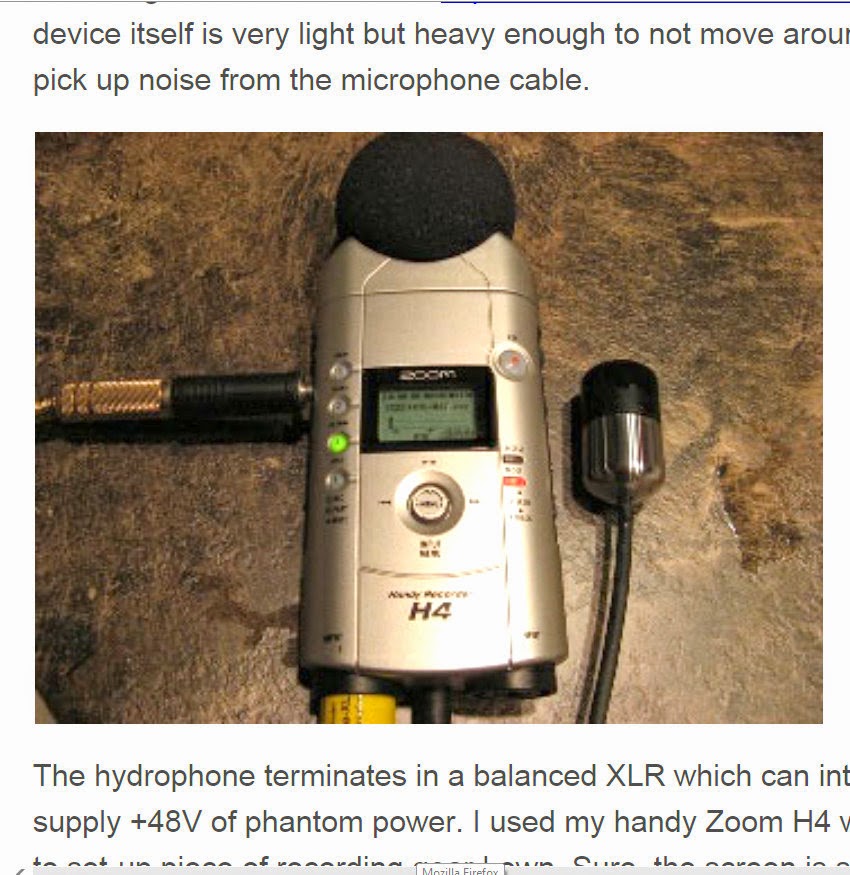
Recent advances in recording tech offer an ideal system for portable recording.
An example would be a new - old stock Zoom H4 - 24 bit 96khz response recorder
and the Aquarian 100 kHz top end hydrophone microphone. Total cost about $350.
It would seem to be one of the best ways of adding a huge credibility boost to the existence of the now rumored to be dead Nessie if acoustic data similar to Fauna's were to be obtained at Loch Ness. It's been thought by many lake monster fans that Champ and Nessie could be the same kind of animal. Bioacoustic data alone might prove this.
 |
| Hip Hip Hooray .... Nessy is OK ! |
Some Champ researchers have pointed out shortcomings. The inability of other parties in obtaining similar data to Fauna, ( Liz claimed it took her 1st team 3 days until they hit paydirt) and Von Muggenthaler's supposed academically unqualified status for recording monster bioacoustics, and the desire of television producers to choose a colorful TV representative. Whether or not any of that is true, it's now been 10 years since the original data and there are no "professional" follow-ups in sight.
There should be no reason that anyone interested nowadays can't take a crack at it. After all, enthusiastic amateurs like Clyde Tombaugh have made many important discoveries and contributions to the world of science, and scientifically "qualified" Lake Cryptid investigators probably won't be crowding the shores of Champlain, Ness or the Okanagan anytime soon.
 |
| Liz VM - From The Thomas Finley Art Gallery |
Liz and team claim to have garnered much valuable data the last 10 years. She says they've collected 200 examples of the bioacoustic signals from her many ventures onto the lake. The signals that she has collected are individually different in subtle ways and she figures that there are at least 15 different animals of the same species creating the signals she's examined.
Whales have previously been the only animal considered able to produce the Champlain bioacoustics ever since the discovery of the signals in 2003.
The new information on Chelodina Oblonga being able to produce similar signals might allow something closely related to them to be considered for the origin of the signals.
The statement that "only whales" produce aquatic bioacoustics is no longer true. A type of snake necked turtle that matches many eyewitness reports of Champ (except for size) is also a producer of aquatic bioacoustics.
 |
| Chelodina |
What if there were a species of un-captured 15 foot long, fully aquatic snake neck turtles in Lake Champlain ? Could they be the producers of the famous "echolocation" signals we've heard so much about ? The only known indigenous reptiles actually living in Lake Champlain are 5 species of water loving turtles. Could it be that there might just be another species yet to be classified ?
Enter: The Plesioturtle
http://aquaticandaerialanomolyassociation.blogspot.com/

 ith all the modern technology